|
( For text with correct
Vietnamese accent marks, go here)
Hon means "island" in Vietnamese;
Non, "mountain," and Bo ,"an artful combination of water,
mountain range and forest," or "copying the way the scenery
(mountain, forest, ocean, animals, birds, structures, and people) looks in
miniature." Hon Non Bo is a mountain landscape reduced in scale, usually
set in an area of the sea close to the shore, often with full, lush
vegetation. The open sea is symbolized by the water in a shallow container;
it is only necessary to have the surface of the water; not a deep ocean, but
merely the waves on the top.
The inspiration for Hon Non Bo comes from the real world and from cultural
beliefs. Making a modern day Hon Non Bo builds on and continues a long
tradition of interest in and the belief of the power of rocks and the beauty
of mountains and plants. Throughout Vietnamese history, Hon Non Bo have been
built by emperors, kings, generals, and other important people as monuments,
decorations, personal vistas, and cultural icons.
|
|
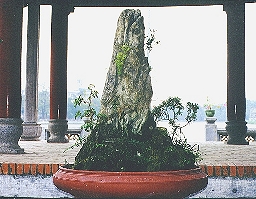
A temple
in Hanoi, North Vietnam, displays this Hon Non Bo. Its age and creator are
unknown.
(Click on picture for larger size, then click
the "back" button on your browser to return.)
|
Hon Non Bo has features that make it
different from other forms of living art. In bonsai, the emphasis is on the
tree(s), usually one to a pot; mountains may be represented by suiseki, a
separate art form, and other vegetation is represented by an accessory plant.
The three elements of tree, rock, and plant suggest a natural landscape in a
sparse, minimalist approach.
In the past, Chinese penjing has made relatively little use of water
features, while Hon Non Bo usually represent islands in a shallow sea. Rock
penjing may feature interesting rocks, intricate and excellent abstract
forms, but not necessarily in the shape of mountains. In Hon Non Bo, the
rocks are arranged always to look like a mountain or a range of mountains.
The long-term historical use of concrete containers is unique to Hon Non Bo.
Bonsai and Penjing use ceramic and marble containers, with some containers
occasionally made of other materials. The white of marble containers does not
set off the mountain scenery of Hon Non Bo nearly so well as the dull-colored
concrete containers and the size of most Hon Non Bo precludes the use of
ceramic containers. It is not unusual to see concrete Hon Non Bo containers which
take four persons to move. Truly skilled artisans can make concrete
containers nearly indistinguishable from ceramic containers.
Bonsai and penjing are usually designed to have a front, a side from which
the tree or the stones look best. Hon Non Bo are designed to be seen from all
sides. Bonsai are displayed so the viewer can look into the center of the
tree; Hon Non Bo are displayed so the viewer can look down on the top of the
display as well. The mountain must look good not just from four sides but also
from the top. Bonsai is half design and half horticulture; Hon Non Bo
requires the artist to be a sculptor to shape the mountain as well as be a
designer and a grower.
Trimming and training trees for a Hon Non Bo is similar to that for bonsai,
except the style may be quite different. For some Hon Non Bo, traditional
bonsai styles are appropriate, even bonsai so carefully designed and shaped
they appear to be pieces of sculpture. For other Hon Non Bo, the tree's style
should be much less sculpted and instead be more natural, even having
somewhat of a wild appearance.
|
|
On the sparser mountains
in Vietnam, trees seem to be falling down the side of the mountains. Vietnam
is a country of monsoons, essentially having six months of hot, dry weather
and six months of hot, wet weather. The trees on the mountains there must
have the ability to withstand the changes in moisture; they reflect the
stress of growing under these conditions, and the trees on Hon Non Bo
should look the same.
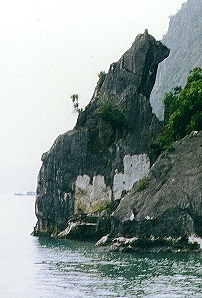
Vietnam's Dog Island (Ha
Long Bay) limestone mountains and "falling" tree seem mimicked in
the work below.
|
|
This Hon
Non Bo work of art, by Lit
Phan, is displayed in the Botanical Building at San Diego's Balboa
Park.
|
|
Hon Non Bo, then, generally represent a
complete mountain scene, often an island mountain scene, in a shallow
concrete container with water to represent the sea.
Tieu canh are mini scenes. The Vietnamese people also enjoy mini scenes and
miniature plants, both of which have a close relationship to miniature
landscapes. The difference between a mini scene and a miniature landscape is
that in a mini scene, the trees must be higher and bigger than the rock which
functions as the background for the trees. The rock may appear to be farther
off in the distance because it is smaller than the tree. A mini scene is part
of a more complete landscape. For instance, a steep cliff, a cave, a beach, a
bank of the river or stream or a lake, and so on are subjects of mini scenes.
The tree in a mini scene is usually in a bending, inclining or growing-down
position. Trees have to be "old, weather-beaten and faint."
The styles of both Hon Non Bo and Tieu Canh continue to evolve. Like other
art forms, new ideas and change are incorporated into modern Vietnamese miniature
landscapes.
Information & History Continued
History & Information
Vietnam Landscapes
Miniature
Landscapes
.
|